Ringing the Changes by Edward Bruce and Nick O’Neill (aaltspace) 2025
Bishop David Delight Major, 33 m x 1.6m; Grandsire Cinques with Covering Tenor, 33 m x 1.6 m: Little Bob Minor, 11 m x 1.6 m; Stedman Doubles, 11 m x 1.6 m
Cotton and viscose woven textile, 11mm Beal Kernmantle polyester-nylon semi-static rope, Petzl Anneau polyester slings, Petzl Mobile Pulleys, ISC Steel ISO Oval Karabiners, PVC rope sleeves, 75kg counterweights x4Nr, 48mm dia painted steel tubes, 3M gripper tape, Acuna anti-slip mat 300GSM, Iazzco 25mm J-Hook Polyester Ratchet Straps.
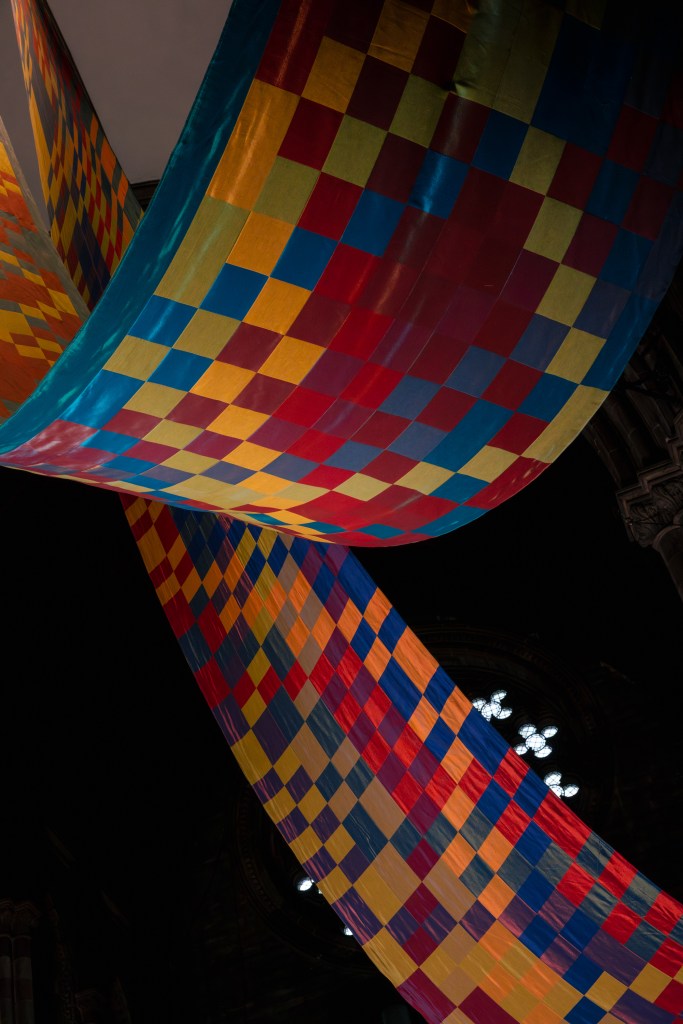
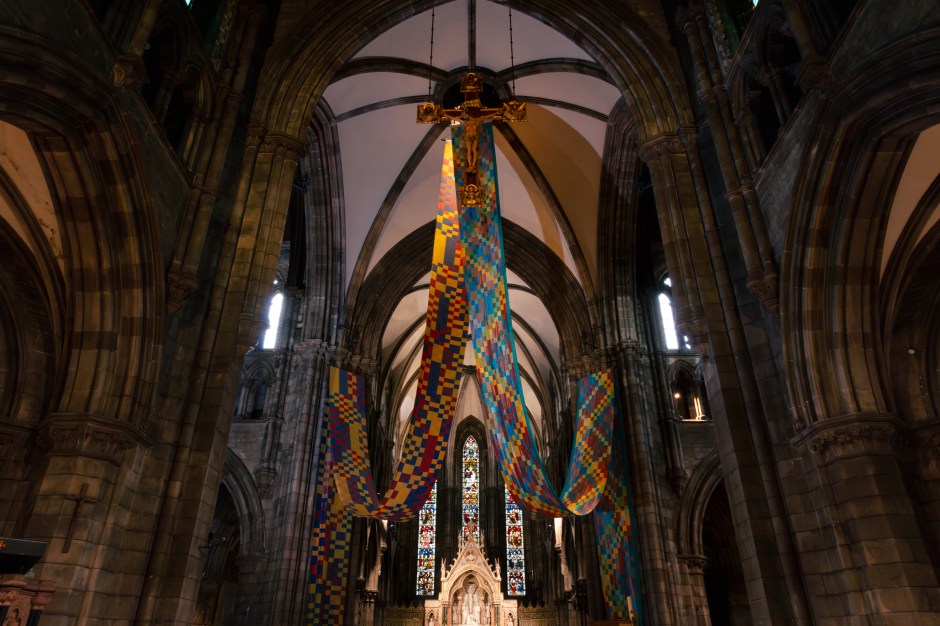
Ringing the Changes is a sonic and visual celebration of bellringing, bellringers and weaving that reveals the art of ‘Change Ringing’ through the craft of woven textile. It forms the centre piece to St Mary’s Festival and its wider cultural programme during August 2025. The work will remain on display until January 2026.
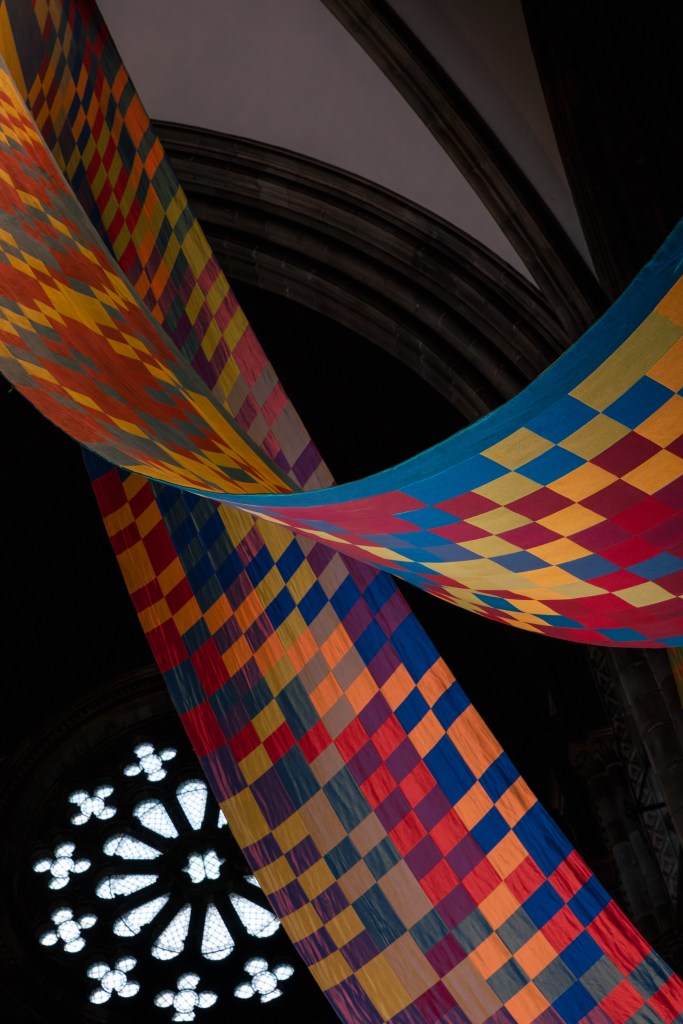
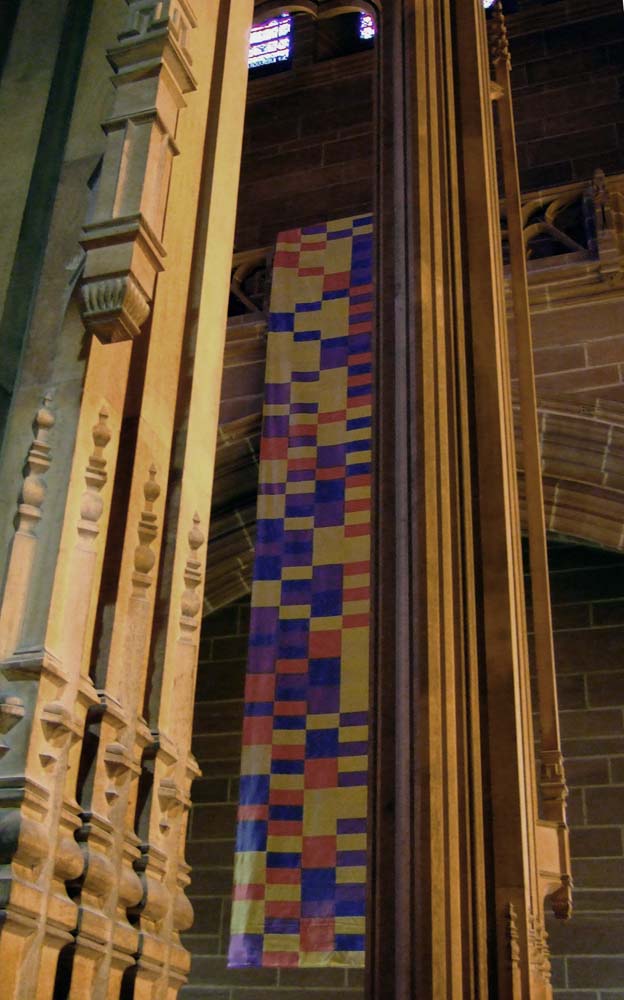
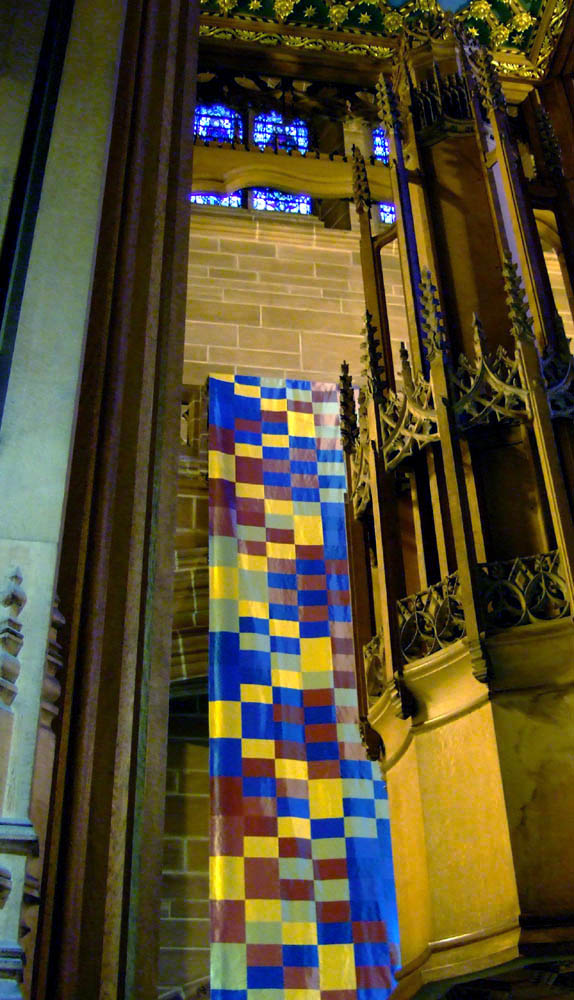
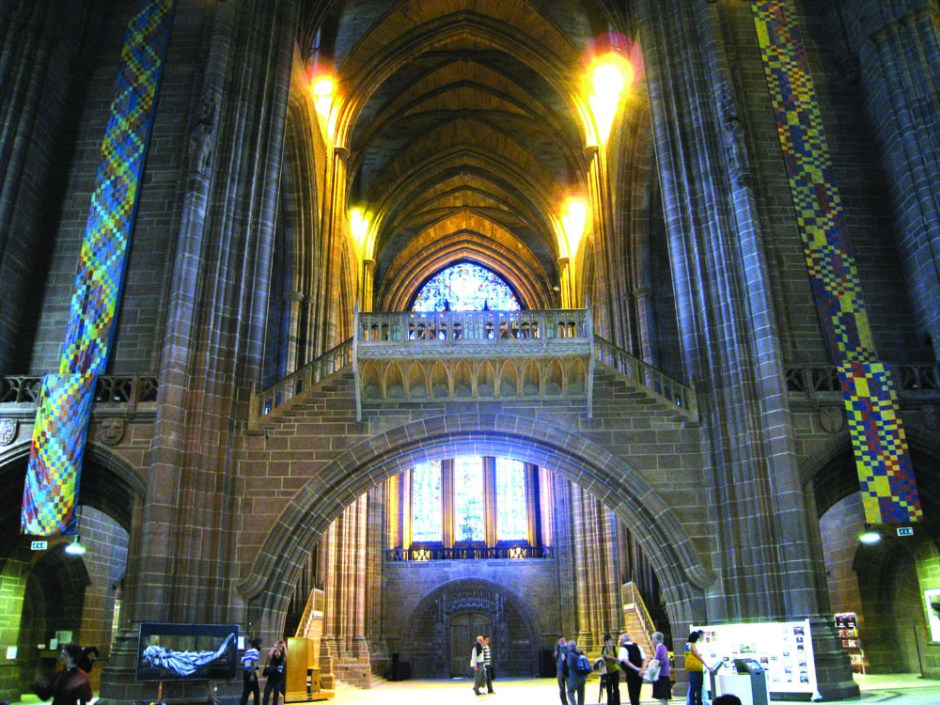
The installation consists of Edward Bruce’s four woven textile Ringing Banners, two 33 m and two 11 m banners combine bellringing, weaving and architecture into one work. Edinburgh Architect Nick O’Neill of aaltspace architects, has designed a dramatic configuration of the banners, suspending the longest of them from the crossing of the cathedral beneath the bell tower and 20m above the Choir. The banners swoop down and cascade from the oculus through which in 1879, the original foundry bells were raised into the belltower. The banners are physical representations of the music of the bells and appear to emanate from the ringing chamber where the bells have been rung for over 150 years by St Mary’s Cathedral Society of Change Ringers. Two 11-metre-long banners are suspended on each side of the nave from the Triforium, framing the whole display.
Taking inspiration from the ancient practice of change ringing by church bellringers, four ringing sequences, known as ‘methods’ have been translated into patterns woven in vibrantly coloured metallic yarns. Bell ringers have rung patterns of sound in changing sequences since the 16th century. Change Ringing can be heard regularly in churches in Scotland, England, North America, Australia and New Zealand, performed by ringers who contribute to the musical and cultural life of our towns and cities.
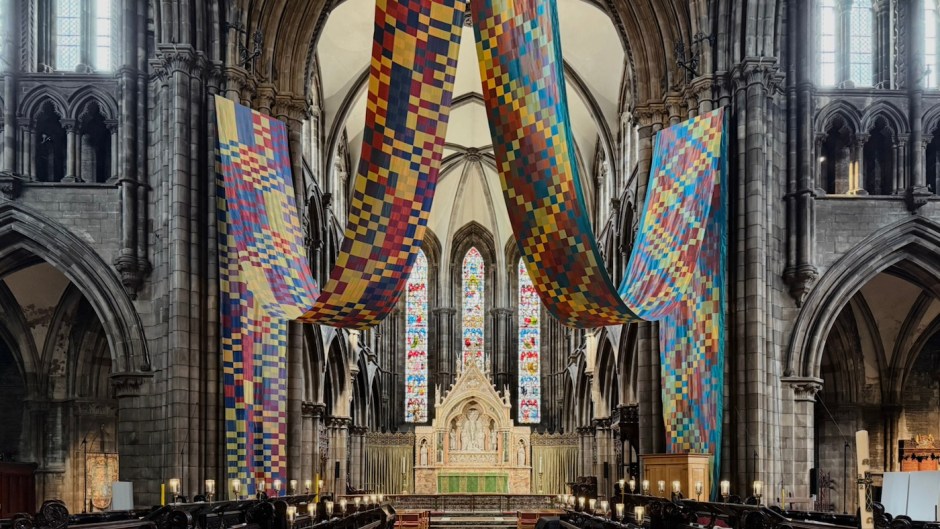 Photo: Nick O’Neill
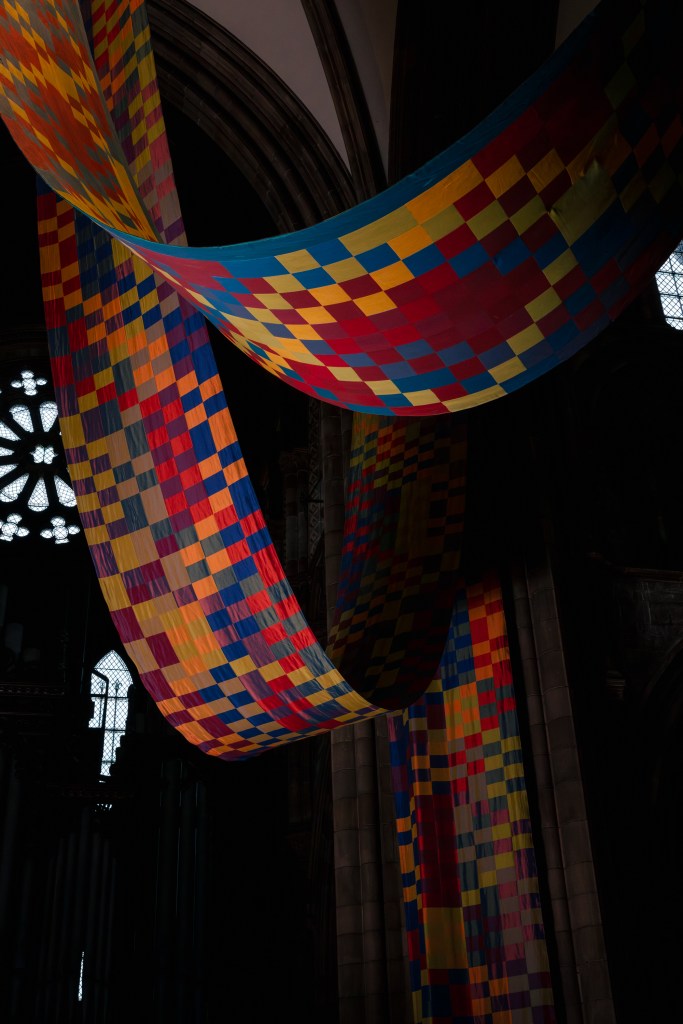
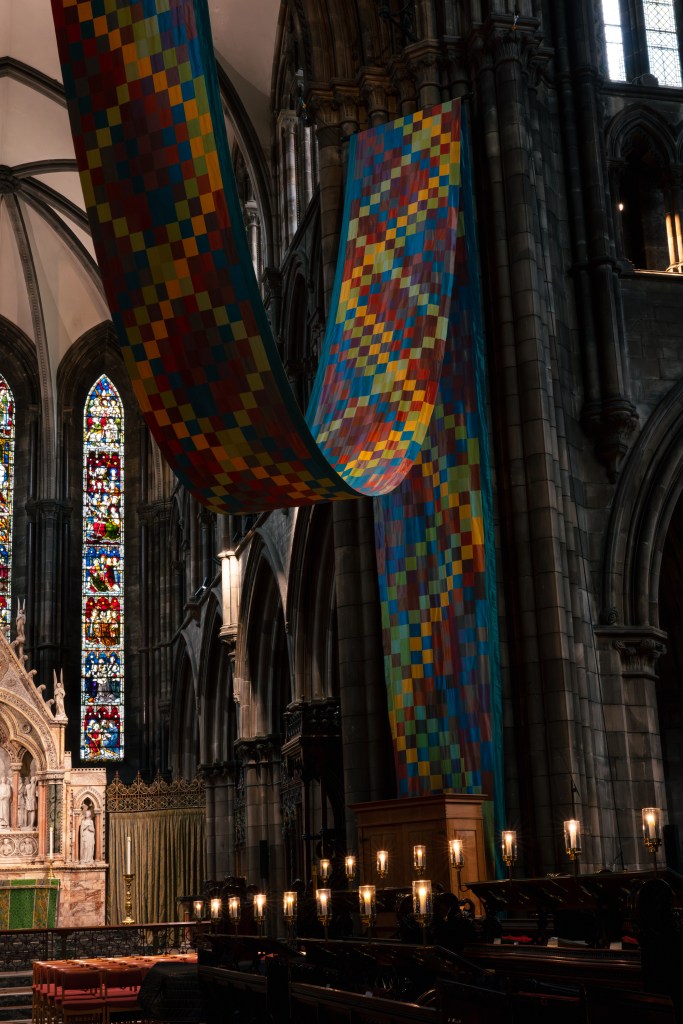
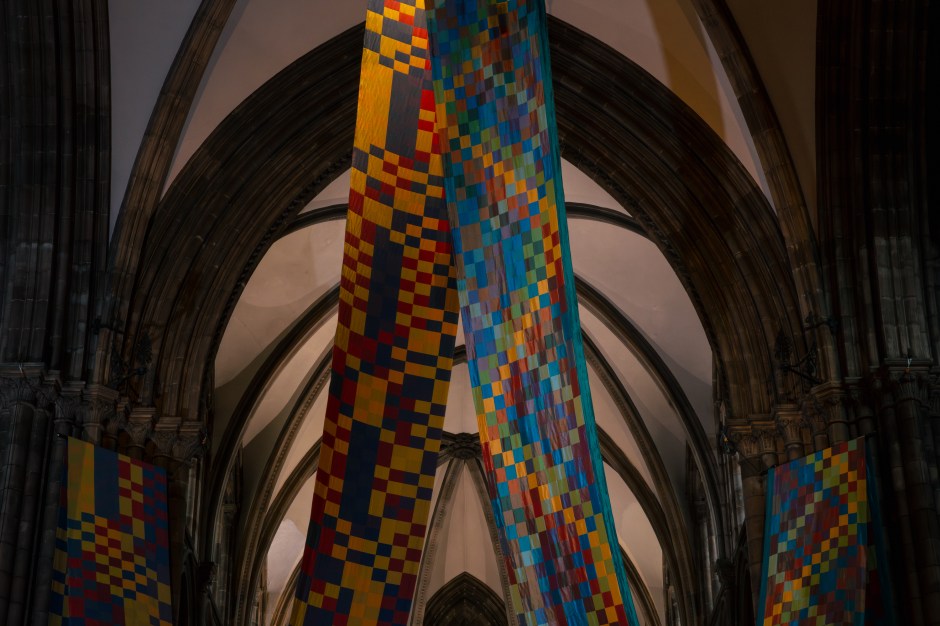
 All photography above (except first image): Alexander Hoyles
Ringing Banners 2008
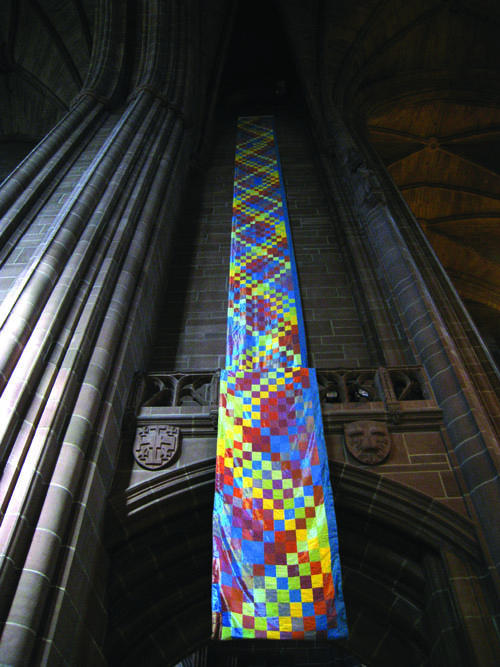
Originally Ringing Banners were made for and displayed in Liverpool Anglican Cathedral in 2008 as part of the European Capital of Culture programme.
Ringing Banners
The digital system (methods) of ringing bells (change ringing) is translated into colour coded blocks that reveal the pattern visually. Each banner is of a different method. They are: Bishop David Surprise Major, Grandsire Cinques with Covering Tenor, Stedman Doubles, and Little Bob Minor. They were rung at the opening by the Liverpool Cathedral Guild of Change Ringers under Ringing Master, Len Mitchell. Ringing Banners is a sonic and visual gesamtkunstwerk incorporating bellringing, weaving and architecture into one work. The banners were woven on a computerized jacquard loom by Herbert Parkinson Ltd. in Darwen, Lancashire, under the supervision of Heather Metcalf.
(Photography: Cathy Carr and Roger Sinek)
Tackled and Lost, 2019
Tramway, Glasgow, part of ‘Relay’ group show curated by ‘Fling’.
Audio work for two stereo pairs of speakers forming a square.
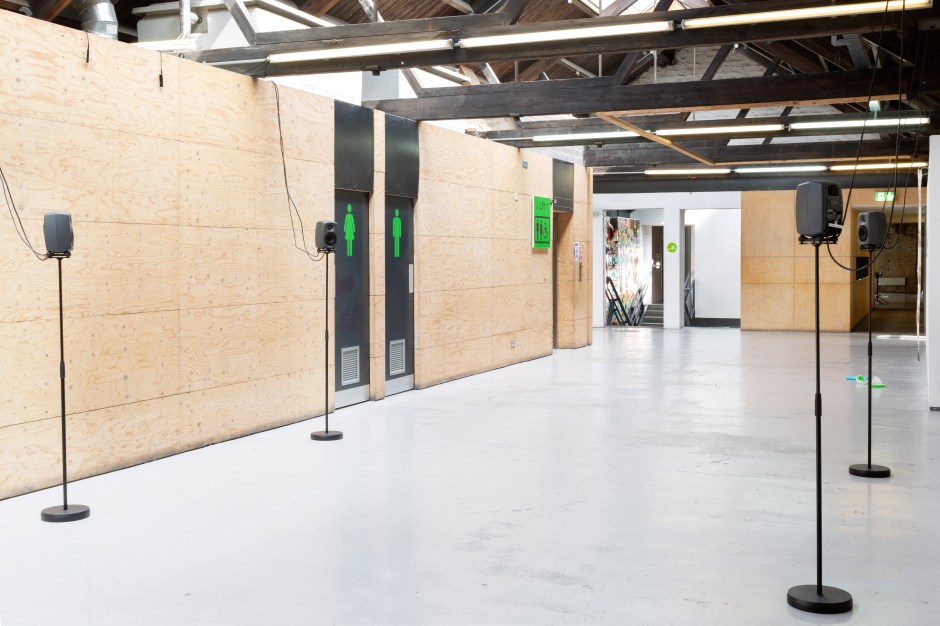
In sound work Tackled and Lost, genders and game codes are ‘mixed’ in a constantly developing hybrid of boys and girls, football and netball in a ‘game’ situation where they are in free play continually. There is no winning and losing: just a mixing, an opposing, a coming together, a breaking apart; all happening constantly in a free matrix which is the space of the imaginary ‘games court’.
In the piece, the listener ‘mixes’ the work themselves by moving around the space marked out between four speakers that represent each ‘player’ aurally combining and recombining their voices in an interactive, protean game of sound and movement.
Performers: Stephanie Black-Daniels, Richard Marsden, Louie Pegna, Tinja Ruusuvuori.
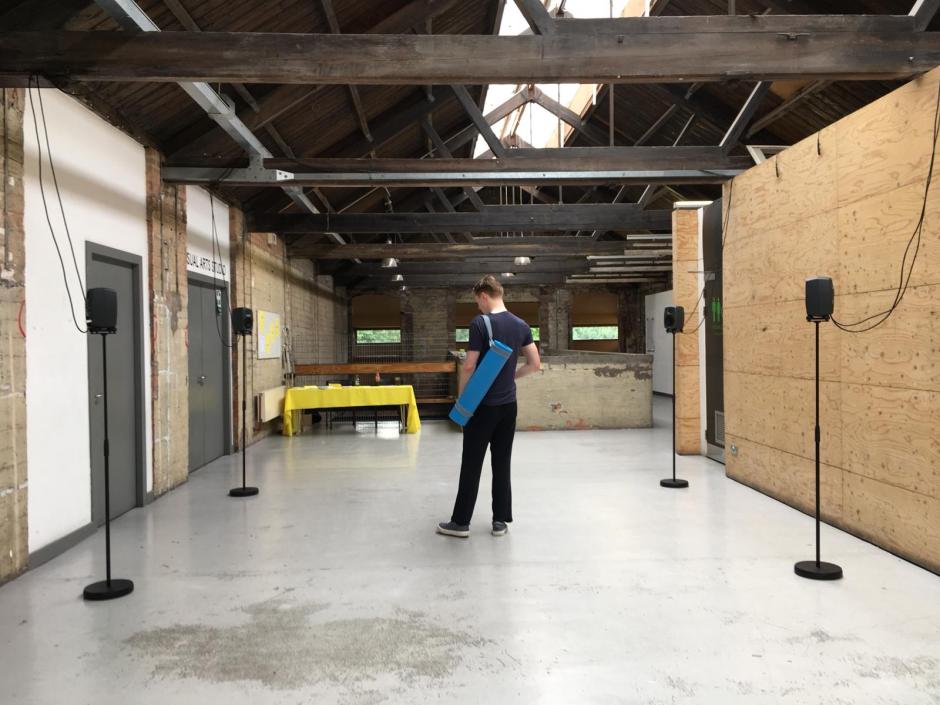
Photo: Tinja Ruusuvuori
Common Ground, 2018
Master’s Degree Show, Tontine Building, Glasgow School of Art, UK


Common Ground is a space where opposites can interact and play in a free matrix exploring how binaries operate and under which conditions they break down. The artworks all employ the mysterious letter forms on the bibs of netball positions (WA, GD, C etc.) as only understood by the girls (as boys do not play netball).
The artworks act as players in a public space where different “language games” (Wittgenstein) are in free-play in one playground.
MLK, 2018, wood, woodstain, steel, 220 cm x 120 cm x 42 cm
Fense (II), 2018, silkscreen on paper, 101.6 cm x 137.2 cm
Fense (III), 2018, silkscreen on paper, 101.6 cm x 137.2 cm
Fense (I), 2018, silkscreen on paper, 101.6 cm x 137.2 cm
Splicer, 2018, digital sound file, speakers, mp3 player, dimensions variable.
Show reel: https://youtu.be/k6Hfh3MdBNY
No step, 2018, paper pulp, pigment, 100 cm x 70 cm
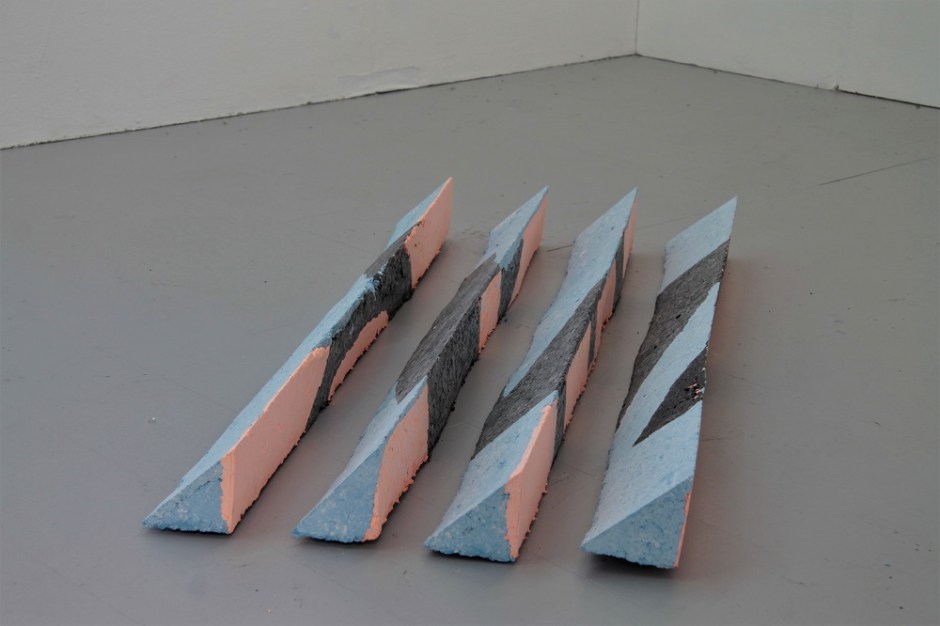
Deconstruction of Difference
“… common ground is the moment when a zero is in the act of changing to an one or vice-versa. The microscopic space of etched silicon that floods with electrons or empties out. A space of the inbetween that is needed by different ‘entities’ in order to differentiate and form identity. The inbetween space is the common ground. It’s both a space and a repeated moment in time. It’s the shared paper, screen and compressed air of speech where words differentiate and divide. Without it there is no system of difference. Without difference we are the same. The common ground allows for difference and therefore identity to be understood but it is also simultaneously a deconstruction of that difference. The interplay of this ensures that there is no stability in an identity based on difference. It’s the common seed that contradicts the rigidly different.”
Douglas Welch, 2018
Match Flags, 2018
Netball position acronyms split and transposed. Utilising the transparency of flag fabric, reversals and overlaying occurs in a code-breaking / encoding exercise.
Made for ‘Jetty’: an exhibition of works by Edward Bruce, Connie Liebschner, Louie Pegna, J.D. Kelly Building at the Glasgow School of Art, 15th February 2018.

Match Flags, 2018, Poly-cotton fabric, acrylic ink, flag: 56 cm x 100 cm, overall dimension variable.
Show Saturday, 2016
Edward Bruce and Ian Mason
Arena Gallery, Liverpool, 9th – 20th September 2016


A pairing of two artists whose work references English country life transformed and disrupted by urban styles. Ian Mason re-forms the ‘dog portrait’ of the Kennel Club breeds. Edward Bruce re-presents model wagons and carts of heritage agriculture overlaid by urban pop art.
The work is united by the theme of the country show, where thoroughbred animals and things are judged and awarded prizes and where people come to honour pedigree and craftsmanship. Show Saturday examines the influence of the country on the town and vice versa. Wagons and carts traditionally painted in the ‘insignia’ of their county colours are altered by ‘pop art’ colour schemes, becoming strange hybrid forms of town and country.
Various model wagons and carts sourced on eBay and re-colour-coded.
Acrylic on wood, plywood panels and trestles. Dimensions variable.
Station Ends, 2016
Three multi-panelled monotypes on Japanese paper
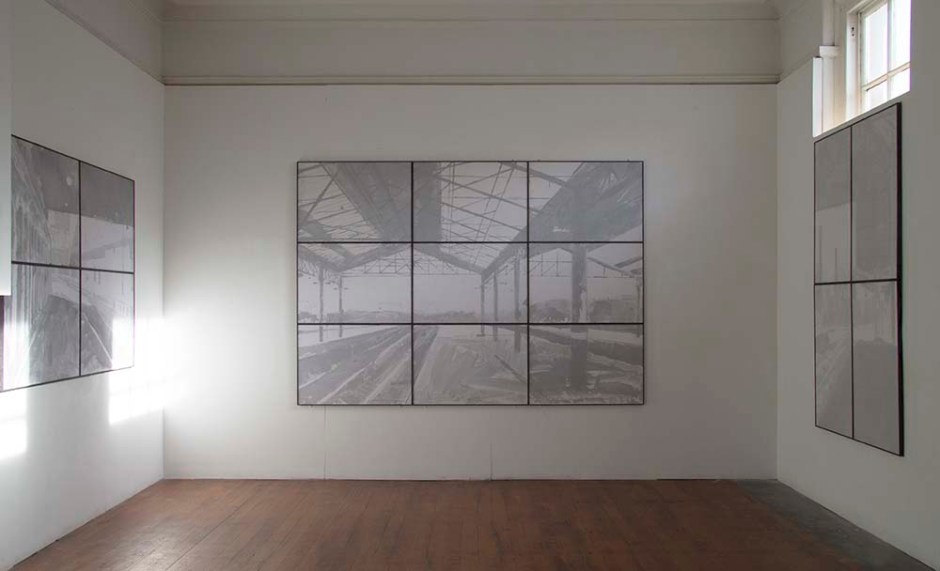
Bridewell Gallery, Liverpool. 8th – 16th October, 2016
A series of monotype prints that explore the architecture and melancholic mood of the platform ends of railway stations. The work evokes the memory of wandering up the platform of a provincial railway station while waiting for a connection. A solitary moment in a public space, an urban townscape framed by the dilapidated grandeur of its railway station and the poetry of departures.
Water-soluble graphite on Sanmore paper, stained ash-wood frames.
Left to right:
BNS, 2016. Four panel. 1.9 m x 1.26 m
ST, 2016. Nine panel. 2.7 m x 1.8 m
PN, 2016. Four panel. 1.26 m x 1.9 m
Reviewed In Art in Liverpool (see Essays)
Secondary, 1998
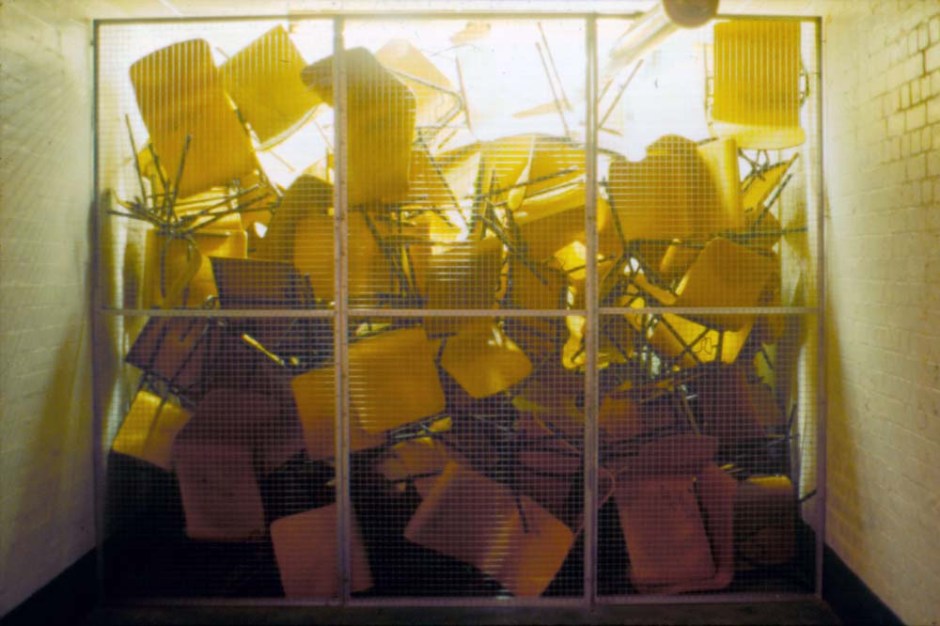
A caged off dead-end space in the basement of an old elevator factory, part of a group show with The Glue Factory Group, Oval, London.
Steel mesh units, school chairs. 3.5 m x 2.4 m (depth variable)
Goal, 1995
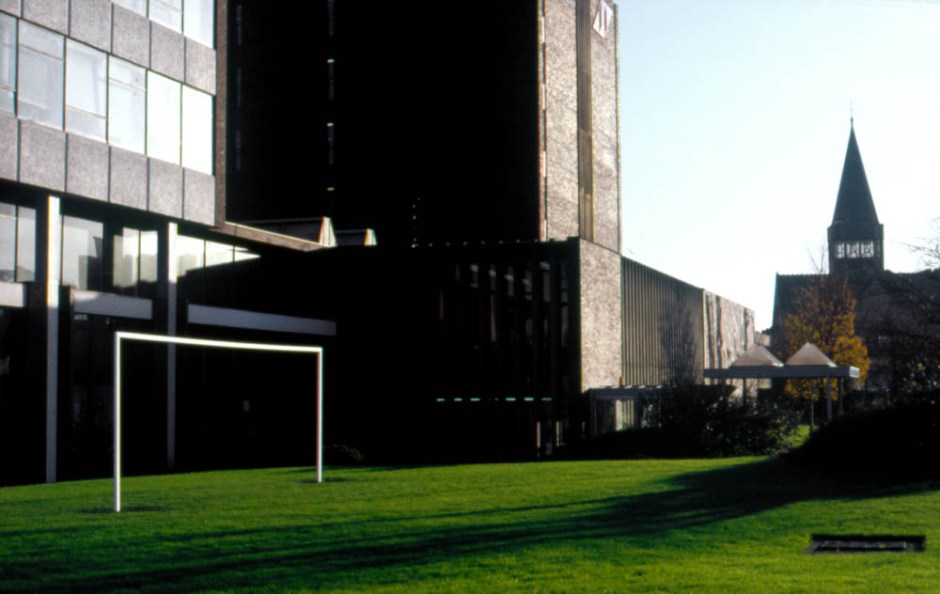
Minimalist wooden site specific sculpture erected on a small strip of grass in the grounds of Northumbria University.
Newcastle upon Tyne, UK
wood, steel, paint. 7.32 m x 2.44 m x 0.12 m²
 Edward Bruce